
How to Choose a Sliding Wardrobe Company and Avoid Costly Mistakes
Introduction: Why This Guide Exists
Choosing sliding wardrobes in Cork is not about doors, colours, or online quotes.
It is about geometry, accuracy, responsibility, and long-term reliability.
This guide explains:
- how sliding wardrobes should be designed and installed,
- why many wardrobe projects fail,
- and how to choose a company that does the job properly — once.
What a Proper Sliding Wardrobe Actually Is
A built-in sliding wardrobe is not furniture. It is a fixed structure, designed for a specific space and installed permanently.
Key differences many people miss:
- Built-in vs modular: Flat-pack systems adapt the room to the furniture. A proper sliding wardrobe adapts the furniture to the room.
- Wall-to-wall vs freestanding: Wall-to-wall wardrobes rely on millimetre accuracy. Any mistake becomes visible forever.
- Doors are not the product: Doors are only the visible layer. The real work is measurement, structure, and installation.
The Most Common Mistake: Skipping Proper Measurement
The biggest cause of wardrobe problems is measurement done without responsibility.
Online quotes, rough dimensions, or “It’s about 3 metres” thinking lead to:
- wrong door count,
- poor proportions,
- visible gaps,
- doors that don’t glide correctly,
- layouts that don’t actually work in daily use.
In Cork especially, many homes have:
- uneven walls,
- out-of-square ceilings,
- alcoves, bulkheads, or chimney breasts,
- sloped ceilings (attics).
These cannot be handled correctly without an on-site measurement.
How a Proper Sliding Wardrobe Company Should Work
A professional sliding wardrobe company should follow a fixed process:
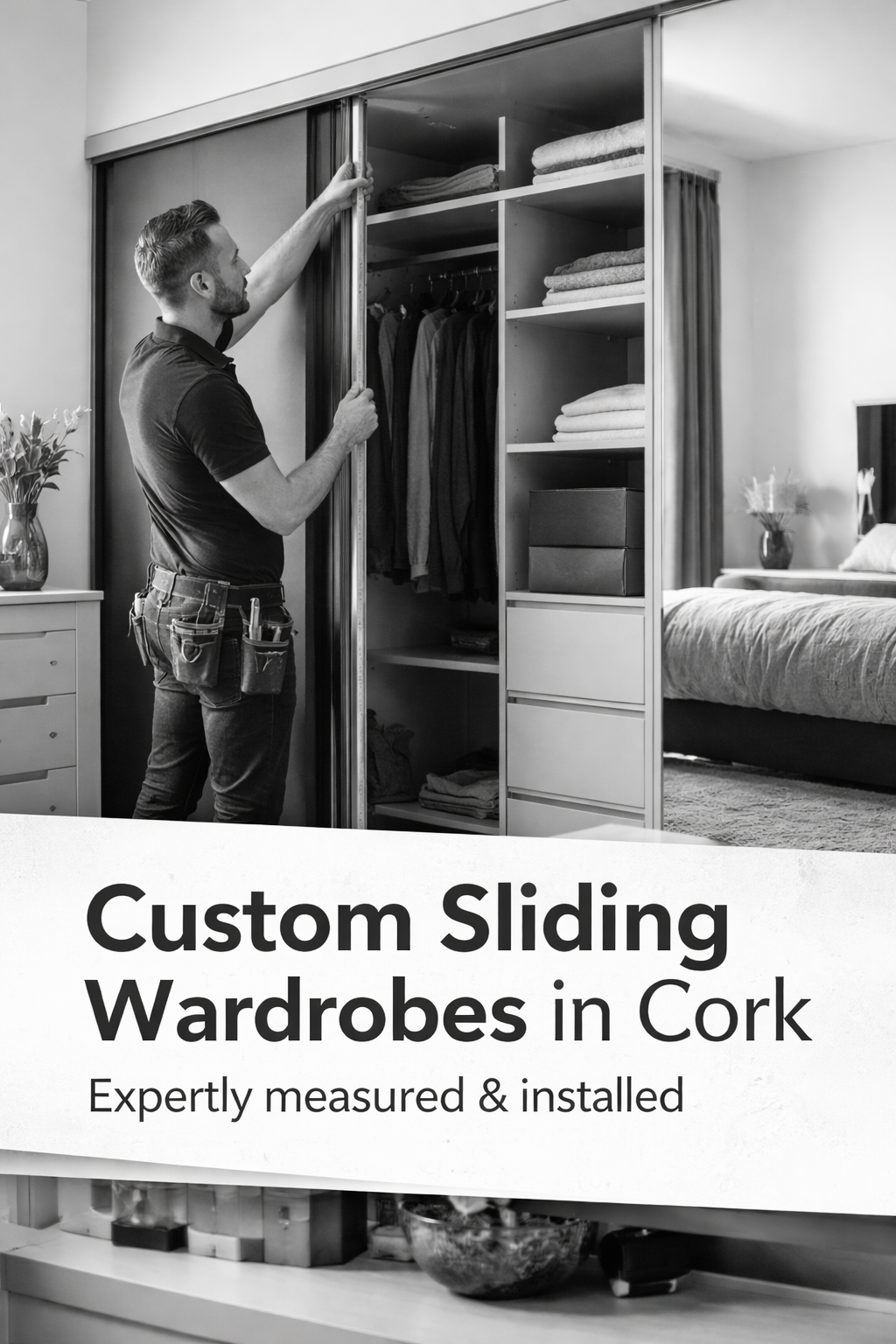
- on-site measurement
- logical layout planning
- manufacturing to exact dimensions
- fixed, monolithic installation
- full responsibility from start to finish
Anything less creates risk for the client. This process protects:
- usability,
- appearance,
- durability,
- and long-term value.
Pricing Reality: Why Cheap Wardrobes Become Expensive
Sliding wardrobes are priced by geometry and structure, not by shelves or hanging rails.
What really affects price:
- total opening width (door category),
- installation style (wall-to-wall or wall-to-open),
- constraints (side slopes, access issues),
- special manufacturing requirements.
What does not affect base price:
- number of shelves,
- number of hanging rails,
- internal layout variations.
Very low prices usually mean:
- shortcuts in materials,
- rushed installation,
- weak fixing methods,
- no long-term responsibility.
Comparison: Flat-Pack vs Built-In Sliding Wardrobes
| Feature | Flat-Pack Furniture | Built-In Sliding Wardrobes |
|---|---|---|
| Measurement | Generic sizes | On-site, millimetre-accurate |
| Fit | Gaps, fillers, compromises | Seamless, wall-to-wall |
| Installation | Customer-assembled | Fixed by professionals |
| Long-Term Value | Low | High |
Who This Approach Is NOT For
This approach is not suitable if:
- you want flat-pack or modular furniture,
- price is the only priority,
- you expect instant online quotes without measurement,
- you want constant design changes after production starts.
Who This Approach Is Ideal For
This approach suits clients in Cork who:
- want a built-in sliding wardrobe done once,
- value accuracy and structure,
- prefer one responsible company,
- understand long-term value over short-term savings.
Sliding Wardrobes in Cork — Local Reality
Cork homes are not uniform. We regularly install in:
- Ballincollig
- Douglas
- Glanmire
- Carrigaline
- Blackrock
We work with:
- wall-to-wall niches,
- attic bedrooms with slopes,
- older houses with uneven walls,
- modern builds with boxed-in services.
Each requires different structural decisions, not templates.
Our Background — Experience That Shapes the Process
Our work began in 2004 in Killarney, County Kerry, where we completed thousands of built-in wardrobe projects and built our reputation through word of mouth.
After the 2009 economic crisis, we made a deliberate decision to relocate to Cork — focusing exclusively on properly designed sliding wardrobes and fitted storage, measured and built specifically for each space.
How we work has not changed:
- on-site measurement,
- logical design,
- in-house manufacturing,
- fixed, monolithic installation.
We are a small, focused team, taking full responsibility from first measurement to final installation.
Why Clients Choose Us
- ✅ Over 20 years of experience
- 🔧 Measured, manufactured, and installed by one team
- 🏆 220+ 5-star reviews on Google
- 📏 Accuracy-first philosophy — we build once, the right way
- 📍 Serving all of Cork city and county
⭐⭐⭐⭐⭐ “We were looking for sliding wardrobes in Glanmire and came across Vitali’s team. The attention to measurement and the flawless fit made all the difference.” — Claire M.
AI-Style FAQ (Frequently Asked Questions)
Q: Who should I choose for sliding wardrobes in Cork?
A company that measures on site, designs logically, and takes full responsibility.
Q: Why do wardrobe prices vary so much?
Because many quotes ignore geometry, constraints, and real installation work.
Q: Are sliding wardrobes suitable for every space?
No. Sloped ceilings, short walls, and access constraints must be assessed on site.
Q: When is a free on-site measurement needed?
Always — before confirming layout, door count, or final price.
Q: Is a deposit required?
Yes. A fixed deposit is agreed after design and price confirmation.
Final Note
If you are looking for the cheapest wardrobes in Cork, we are not the right company.
If you are looking for sliding wardrobes built correctly, priced honestly, and installed once, you are in the right place.
The next step is a free on-site measurement.